The State of AI in Flooring: Adoption, Challenges, and What’s Next
- 13 Nov, 2026
- Steven Wang
- Uncategorized
From takeoff and estimating to project management, a look at where AI is delivering real value for flooring professionals, what's holding adoption back, and what's next.
Artificial intelligence is gaining ground in construction, but for flooring contractors and estimators, its value comes down to a practical question: Can it handle the complexities of real flooring projects and make everyday work more efficient?
The industry is making progress. According to the 2026 Houzz State of AI report, 41% of construction and design firms now use AI for everyday tasks, up from 34% a year earlier. More than half of those using AI report saving at least three hours a week.
Flooring is following a similar trajectory. Floor Covering News identified 2026 as an inflection point for AI in flooring retail, with software providers increasingly incorporating AI into their platforms.
Yet there's a difference between AI that performs well in a demonstration and AI that can handle complicated plan sets, finish schedules, material requirements, and tight bid deadlines. Understanding where the technology delivers value, where it still falls short, and how to evaluate it is becoming increasingly important for flooring professionals.
What's holding AI adoption back?
Despite growing interest, AI adoption across construction remains uneven. Royal Institution of Chartered Surveyors (RICS) surveyed construction professionals worldwide and identified several leading barriers, including a shortage of skilled personnel (46%), integration with existing systems (37%), and data quality (30%).
For flooring contractors and estimators, these challenges take several forms:
- Trust and accuracy: If an estimator has to recheck every room an AI tool draws, the time savings quickly disappear. Results need to be accurate enough to provide a useful starting point while remaining easy to review and correct.
- Flooring-specific requirements: Recognizing square footage is only part of the job. Flooring estimates also need to account for seams, roll widths, pattern repeats, material waste, and installation requirements that generic construction tools may not address.
- Disconnected systems: When AI-generated quantities still need to be entered manually into spreadsheets, bids, and work orders, teams lose time and introduce additional opportunities for error.
- Plan quality: Scanned drawings, crowded floor plans, and inconsistent documentation can challenge even advanced AI tools. Clean vector PDFs generally produce better results, while less consistent drawings require more human review.
These limitations help explain why adoption isn't simply a matter of adding AI to an existing process. To deliver meaningful value, the technology needs to work with the realities of flooring estimating and fit into the systems contractors already use.
Where AI is already making a difference for flooring estimators
Some of AI's most valuable applications happen before the first room is measured.
A 100-page construction plan set might contain only a handful of sheets relevant to a flooring estimator. Identifying those pages, reviewing finish schedules, locating specifications, and determining the scope of work can consume hours before the actual takeoff begins.
AI can help reduce that preparation time while also supporting the estimating and project management work that follows.
Here's where AI is already helping flooring teams:
- Finding relevant sheets: Identifying floor finish plans, schedules, and related details within large drawing sets so estimators can focus on the information they need.
- Reading finish schedules: Extracting product codes such as CPT-1 and LVT-2, along with available manufacturer, style, and color information, to help build material lists.
- Summarizing project scope: Providing an overview of the work associated with a particular trade so teams can assess project requirements and decide which opportunities to pursue.
- Identifying drawing scales: Detecting scale information on plan sheets to reduce manual setup, with verification where needed.
- Automating room takeoff: Recognizing room boundaries, doors, and labels to generate an initial takeoff that estimators can review and refine.
- Monitoring active projects: Analyzing project information to identify potential issues, such as overdue invoices, unapproved change orders, and unanswered communications, before they create larger problems.
The value of these capabilities depends on the quality of the input data, the software being used, and the amount of review required. AI-generated results should support professional judgment rather than replace it.
As Jim Riherd, VP of Operations at Measure Square, explains:
"AI is a tool. It's a co-pilot for you. It's not going to be perfect, but going back and fixing small errors is a much faster workflow than doing everything from scratch."
This distinction is important. AI doesn't need to complete every task perfectly to be useful, provided it reduces the work required to reach an accurate, reliable result.
What AI still can't replace
While AI can take on repetitive tasks, flooring estimating requires experience and judgment that extend beyond recognizing rooms or extracting quantities.
Estimators still need to interpret ambiguous specifications, account for installation conditions, evaluate material requirements, identify scope gaps, and determine how to price a project competitively without compromising margins.
AI can help surface information and accelerate parts of that process, but the responsibility for reviewing the results and making those decisions remains with the estimator.
"AI won't replace flooring professionals, but professionals who use AI will outpace those who don't," Riherd said.
The opportunity is to shift more of an estimator's time away from manual preparation and toward the work that depends on their expertise. For contractors looking to increase estimating capacity, that can mean evaluating more opportunities and producing more bids without expanding headcount.
How to choose AI takeoff software for flooring
With more AI-powered tools entering the market, contractors need to look beyond feature lists and demonstrations to determine what will actually improve their workflows.
The best AI takeoff solution is one that saves time on real projects, produces results estimators can trust, and connects those results to the work that follows.
These seven questions can help guide the evaluation:
- Is it built for flooring? Look for software that supports flooring-specific requirements such as seam layouts, roll and tile optimization, waste factors, and pattern matching, rather than relying on manual calculations outside the takeoff.
- Does it read the plans, not just draw rooms? Automated room detection is useful, but the ability to identify relevant sheets, extract finish schedules, and organize product information can save significant preparation time.
- Can you review and correct the results? Estimators should be able to inspect and edit AI-generated information before using it in a project, ideally with a direct link back to the source drawing.
- How does it perform on your drawings? Ask vendors to demonstrate their software using one of your own recent plan sets, including the scanned or complex drawings your team regularly encounters.
- Does the information flow into the rest of the project? Takeoff quantities should connect to estimating, proposals, purchasing, change orders, and invoicing without unnecessary reentry.
- Is the technology continuing to improve? Look for evidence of ongoing development, user feedback, and meaningful improvements to accuracy and functionality.
- What support is available? Industry expertise, accessible training, and responsive technical support matter, particularly when questions arise close to a bid deadline.
Before committing to a solution, test it on actual projects and measure the results. Compare the time spent preparing and completing takeoffs, the corrections required, and any errors that remain after review.
A tool's value should ultimately be measured by the improvements it delivers to your estimating process, not simply how quickly it generates an initial result.
AI designed for real flooring workflows
At Measure Square, AI development starts with the challenges flooring professionals face every day, from navigating complex plan sets and preparing accurate estimates to managing projects after the bid is won.
These capabilities are built into MeasureSquare 8 and MeasureSquare CRM, connecting AI-assisted work to the estimating and project management processes teams already rely on.
Faster Plan Analysis and Estimating with MeasureSquare 8
MeasureSquare 8 helps flooring estimators reduce the manual work involved in reviewing construction documents and preparing takeoffs.
AI Plan Analyzer identifies relevant sheets, summarizes project scope, and extracts product information from finish schedules. It can also pull and automatically scale the drawings needed for takeoff, while allowing estimators to ask questions about the plans and locate details more quickly.
AI Takeoff automates room drawing by detecting room boundaries, doors, and labels, giving estimators a starting point they can review and refine.
As Reid Olsen, Estimator at Arkblu Surfaces, described:
"It calculated the square footage and labeled all the rooms within 30 seconds. Drawing it manually would have taken me 10 to 15 minutes."
The benefit extends beyond the initial takeoff. AI-generated measurements feed into MeasureSquare 8's estimating tools, where teams can account for seam layouts, material optimization, and installation requirements before preparing their bids.
Other tools, including trade symbol search and Blueprint Compare, help teams identify material locations and review changes between drawing versions.
For customers, these capabilities can translate into substantial time savings.
"Using AI Takeoff helped me go from 50 to 100 estimates a month."
Jude B., Design Construct Flooring
"AI Analyzer separates finished plans and lists products, specs, and vendors, saving me hours of page-flipping."
Jordin M., Seamless Flooring
Importantly, the AI-generated information feeds into MeasureSquare 8's flooring estimating tools, where teams can account for seam layouts, material optimization, and other installation requirements before preparing their proposals.
Better project visibility with MeasureSquare CRM
The potential value of AI doesn't end when an estimate is submitted. Once a project is underway, contractors need to manage schedules, costs, approvals, communications, and billing, often across multiple jobs at the same time.
MeasureSquare CRM connects these activities in a takeoff-centered project management platform, with AI tools designed to help teams stay informed and identify issues earlier.
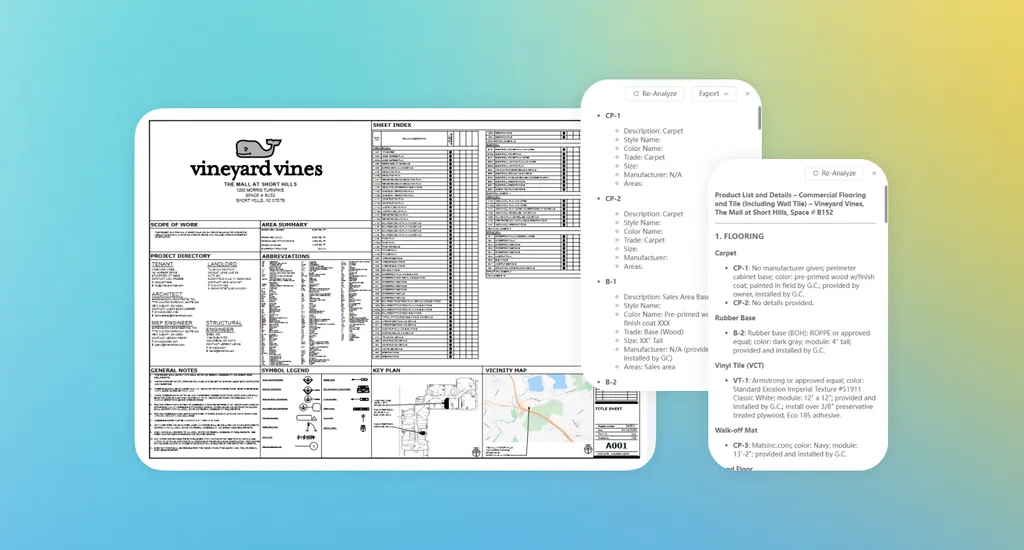
AI Plan Analyzer allows teams to review plan sets within a CRM project, providing scope summaries, finish information, and relevant drawing sheets. This helps teams identify missing information or potential scope gaps before committing resources to a bid.
AI Project Analyzer takes a broader view of active projects, reviewing available project information for risks such as overdue invoices, unapproved change orders, and unanswered client communications. It prioritizes issues by urgency and helps users take action through tasks and drafted emails. Within individual projects, it can also provide summaries, timelines, proposal analysis, and risk information.
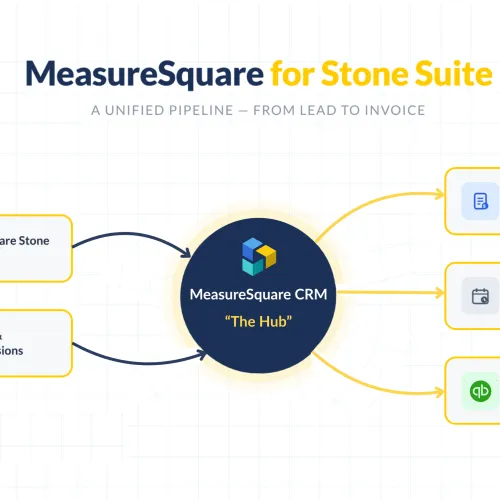
These capabilities become more useful when the underlying project data is connected. Because Measure Square takeoff information flows into CRM, teams can carry quantities and project details into proposals, change orders, and invoicing without repeatedly entering the same information.
The result is an opportunity to improve efficiency across the project lifecycle, rather than saving time on one task only to lose it elsewhere.
What's next for AI in flooring?
As AI capabilities mature, the next phase of development is likely to focus less on producing impressive initial results and more on improving accuracy, simplifying review, and connecting information across workflows.
For flooring estimating, this means making it easier to correct AI-generated takeoffs, handle complex drawings, and extract more useful information from construction documents. Beyond estimating, AI has the potential to play a larger role in tracking revisions, identifying project risks, and helping contractors respond before small issues affect schedules or margins.
Measure Square's AI roadmap reflects several of these priorities, with planned developments including:
- AI Takeoff 3.0: A larger model update aimed at improving room-capture accuracy.
- Faster takeoff corrections: Tools designed to simplify adjustments to missed corners, misaligned walls, and other room-drawing issues.
- AI Plan Analyzer 2.0: More customizable prompts and improvements to the quality and scope of plan analysis.
These features are planned developments and may change as testing and development continue.
The broader direction is toward AI that supports more of the project lifecycle, from interpreting the initial drawings to monitoring work in progress. For contractors, the greatest benefit may come from connecting these improvements so information moves more efficiently between estimating, operations, and accounting.
Frequently asked questions about AI in flooring
What is the best AI takeoff software for flooring?
The best AI takeoff software should do more than automatically draw rooms. Look for a solution that can interpret plan sets, extract relevant information, and work with flooring-specific estimating requirements such as seams, roll widths, and waste. It should also allow users to review and correct results and transfer takeoff information into downstream workflows without unnecessary manual entry.
Is AI takeoff accurate enough to bid from?
AI takeoff can provide an accurate starting point, but estimators should review the results before using them in a bid. Accuracy depends on factors such as drawing quality, plan complexity, and the capabilities of the software. Clean vector PDFs generally produce better results, while scanned or crowded drawings may require additional corrections.
Will AI replace flooring estimators?
AI is more likely to change how estimators work than eliminate the need for their expertise. By automating repetitive tasks such as locating drawings, extracting finish schedules, and generating initial room outlines, AI can give estimators more time to focus on scope interpretation, pricing, risk assessment, and bidding strategy.
Does AI takeoff software work offline?
Many AI-powered features rely on cloud processing and require an internet connection. MeasureSquare's AI Plan Analyzer and AI Takeoff are examples, although MeasureSquare 8's core estimating tools can still be used offline with an active license.
How is AI takeoff different from traditional automated takeoff software?
Traditional automated takeoff tools generally rely on predefined rules, such as tracing lines or counting symbols. AI takeoff uses trained models to recognize elements such as rooms, labels, and schedules across different plan sets. These models can improve through continued development and training, although their results still require appropriate review.
The bottom line: AI is becoming a practical advantage
AI in flooring is moving beyond the experimental stage, with tools already helping teams navigate complex plans, reduce repetitive work, and identify information that might otherwise be overlooked.
But adopting AI alone doesn't guarantee better results. Its value depends on how accurately it performs, how easily professionals can review its work, and how well it fits into the processes contractors already use.
For flooring businesses, the opportunity is to combine the speed of AI with the expertise of their teams, creating more capacity to bid, better visibility into active projects, and more time to focus on the decisions that drive profitability.
See AI in action on your own plans
The best way to evaluate AI takeoff is to test it on a real project. Start a free MeasureSquare 8 trial to explore AI Plan Analyzer and AI Takeoff, or watch our webinar replay, Won the Bid, Keep the Margin: Project Control & AI Monitoring, to see how AI Project Analyzer supports project management in MeasureSquare CRM.
Sources
- Houzz: AI Adoption Rises in Construction and Design, Wood Floor Business, September 2, 2026
- AI for Contractors, Dodge Construction Network and CMiC, December 5, 2025
- RICS Artificial Intelligence in Construction Report 2025, RICS, September 12, 2025
- Artificial Intelligence: The Next Frontier, Floor Covering News, January 29, 2026