The Drawing Is the Job: Why Stone & Tile Fabricators Need a Connected Digital Workflow
- 11 Sep, 2026
- Blanca Torii
- Uncategorized
Key Takeaways
- One drawing can carry the job from estimating through production, reducing the need to re-enter or reinterpret information between teams.
- Stone-specific tools such as slab optimization and 3D modeling help contractors estimate more accurately with less manual work.
- Clearer shop drawings and consistent part names can prevent scope gaps, miscommunication, and costly rework.
For stone and tile contractors, fabricators, and installers, the drawing is more than a visual representation of a project. It contains the dimensions, materials, quantities, layouts, edge details, phases, and other information that determine what gets sold, fabricated, installed, and ultimately paid for.
So what happens when that information is scattered across multiple systems?
The estimator measures in one program. The salesperson builds a quote somewhere else. The shop redraws the job. The installer works from different part names. Someone updates a spreadsheet. Someone else discovers that the scope changed. Every handoff creates another opportunity for information to be lost, re-entered, or misunderstood.
MeasureSquare Stone & Tile takes a different approach: the drawing is the source of truth.
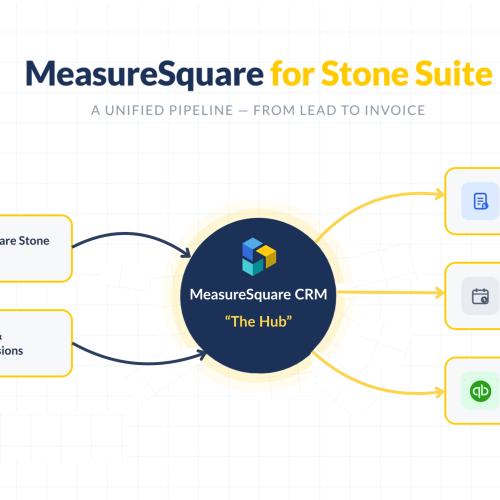
Instead of treating takeoff, estimating, shop drawings, and production as separate steps, MeasureSquare Stone & Tile connects them around a single digital job file. One drawing can drive the quote, shop drawings, slab layout, cut list, and installation workflow without requiring the same information to be entered again at every stage.
The result is a more connected way to manage the work, with the information created during estimating continuing through production instead of being recreated along the way. For contractors and fabricators, that can mean more estimating capacity, fewer costly mistakes, better material decisions, and greater confidence in what is being sold and built.
From Takeoff to Production Without the Information Handoff
Many stone and tile operations have assembled their technology stack over time. They may use one tool for PDF measurement, another for countertop drawings, an accounting system for pricing, and a separate system for scheduling or inventory.
The problem isn't necessarily that any individual tool is bad. The challenge is what happens between them.
A takeoff may contain one set of measurements and a quote another. The shop may interpret a part differently than the estimator intended. When a change occurs, someone has to figure out which systems need to be updated. That is where rework begins.
MeasureSquare Stone & Tile is designed to keep that information connected. A job can be drawn from a plan, field measure, or DXF from a templating device, then modeled in 3D with stone-specific details such as radius walls and waterfalls. That same information can flow into estimating, shop drawings, material planning, and production.
Instead of rebuilding the job at each stage, teams can continue from the same digital file.
The goal isn't simply to use fewer programs, it's to keep the information created at the beginning of a project useful all the way through production.
The Real Cost of Getting the Drawing Wrong
In stone and tile, an estimating mistake rarely stays an estimating mistake. A missed scope item can become an expensive change order, or an expense the contractor has to absorb. An incorrect slab count can leave a contractor with excess material or require an emergency order. Inconsistent part names can create confusion between estimating, templating, fabrication, and installation.
The cost isn't limited to the material. It can also mean additional labor, shop time, scheduling problems, customer communication, and management time spent figuring out what went wrong.
One Measure Square customer described a previous process where different people used different names for the same part. The estimator called it "C8," the templator called it "the back bar," and production called it "part A." Once a change occurred, reconciling the information became difficult, and rework became part of the process.
A consistent digital workflow helps address that problem at its source.
When the same tag and part structure carries from takeoff through CAD, templating, production, and installation, everyone is working from the same terminology and underlying information. Problems are easier to catch before they become expensive problems for the shop or jobsite.
More Accurate Slab Planning, Less Guesswork
Slab optimization is a good example of what happens when stone-specific intelligence is built directly into estimating. Instead of manually counting slabs and laying out every unit, estimators can nest parts against actual slab dimensions, vein direction, waste, and project phasing.
For a small residential job, that can save some estimating time. For a 150-unit multifamily project, the difference can be much greater.
One Measure Square customer reported reducing estimating time on large multi-unit projects from roughly six to seven hours to about 1.5 hours. Another described a situation where manually ordering 13 slabs would have been unnecessary because the optimizer showed that 11 slabs would comfortably accommodate the job.
That matters because material planning is directly tied to project cost. Knowing how parts will fit on actual slabs before placing an order gives contractors a better basis for purchasing decisions and reduces the risk of discovering a shortage after production has already begun.
Shop Drawings That Show What Was Sold
A typed scope description can tell a shop what a contractor intends to provide. A drawing can make that scope much easier to understand.
MeasureSquare Stone & Tile can automatically generate shop drawings with top sizes, unit counts, colors, edge details, and other project information, giving the customer, estimator, templator, and shop a clearer view of what is included. That visual clarity can help close gaps before they become expensive.
One Measure Square customer reported that missed scope items such as wall cladding had previously resulted in $5,000 to $10,000 in absorbed costs per project. With the scope represented visually, those details are easier to identify before the contract is finalized.
The value goes beyond producing a more polished drawing. It gives everyone another opportunity to make sure the scope that was quoted is the scope everyone understands before fabrication begins.
Bid More Work Without Adding More Estimating Hours
Estimating capacity can become a real constraint as a business grows.
If an estimator spends several hours measuring a project and then has to recreate that information in other programs, there is a natural limit to how many opportunities the team can pursue. More work can mean more estimating hours or another estimator.
A faster takeoff process changes that equation.
One Measure Square customer reported producing two to three times the volume of estimates while maintaining what they described as 99% auto-scaling accuracy on uploaded plans. Another replaced Bluebeam and reported that takeoffs were significantly faster and more accurate.
The business benefit is the capacity that comes with that efficiency. An estimating team that can work through more opportunities has more flexibility to pursue the projects that make sense for the business without automatically increasing headcount.
Turn Value Engineering Into a Sales Advantage
Connected estimating can also change how contractors respond when customers want to explore different options.
Instead of rebuilding a project every time a customer asks, "What if we used a different material?" estimators can swap materials or slab sizes and see the effect on cost and yield without starting the takeoff over.
That makes it easier to have a more informed conversation about price and alternatives.
One Measure Square customer described being able to quickly present multiple options and demonstrate the value behind each one. He credited that capability with helping his commercial close ratio increase from the single digits to 20%, while working from a similar, slightly lower estimated dollar volume.
Rather than responding to budget concerns with another round of manual estimating, the estimator can use the model to evaluate alternatives and show the customer how those choices affect the project.
The software becomes part of the sales conversation, not just a tool for calculating quantities.
Where MeasureSquare Stone & Tile Fits in the Competitive Landscape
The stone and tile software market has plenty of capable tools. But many approach the workflow from different starting points.
The distinction is less about whether another product can perform a particular task and more about where that task sits within the overall workflow.
Moraware: Connected Products, Separate Workflows
Moraware's CounterGo and Systemize products address important parts of the countertop business, particularly estimating and scheduling. But they remain separate products connected through integration.
MeasureSquare Stone & Tile differentiation is that the drawing itself carries the job forward, from takeoff to shop drawing to production.
For a contractor, that means fewer opportunities for information to change as it moves from one system to another.
Bluebeam and PlanSwift: Powerful General-Purpose Takeoff
General-purpose takeoff tools can be useful across many construction applications. But stone has its own requirements: sdimensions, vein direction., yield, edge profiles, splashes, laminations, part-level material information.
MeasureSquare Stone & Tile builds these concepts directly into the workflow rather than asking stone professionals to adapt a general construction takeoff process to their trade.
The difference is important: software designed around the trade can account for the details that matter to the people actually estimating and fabricating stone.
ERP-First Platforms: Start With the Back Office
ERP-first systems approach the business from inventory, purchasing, accounting, or back-office management, with estimating and CRM capabilities layered into that environment. MeasureSquare Stone & Tile takes a different approach.
The estimate and the drawing drive the workflow downstream. The drawing isn't simply an output. It becomes the foundation for the job record and the information that moves into production.
Generic CRMs: Built Around Contacts, Not Jobs
A traditional CRM is designed to answer questions like: Who is the customer? What opportunities are open? When did we last contact them?
Those questions matter. But a stone and tile contractor also needs to know:
How many slabs does this project require?
What is the yield?
Which parts are included?
What changed?
What is being fabricated?
What was actually sold?
Generic CRM platforms are built around customer relationships and activities. MeasureSquare Stone & Tile is built around the job itself.
That distinction can be captured in a simple question:
Can your CRM calculate material yield from a floor plan?
The Business Benefit: More Than Faster Takeoffs
It can be tempting to evaluate estimating software by asking one question:
How much faster can I measure a job?
Speed matters, but it is only part of the value.
The bigger opportunity comes from what that additional capacity and connected information allow a business to do.
When estimates can be produced faster, teams can respond to more opportunities without automatically increasing estimating headcount. When material requirements are clearer, purchasing decisions become easier to evaluate. When the scope is represented visually and the same part information carries through production, there are fewer opportunities for misunderstandings to become rework.
And when estimators can quickly model different materials, slab sizes, and pricing scenarios, they can have more productive conversations with customers about their options.
Taken together, these capabilities give contractors something that is difficult to get when their workflow is spread across disconnected systems: a clearer picture of the job and greater control over what happens next.
For the estimator, that can mean more capacity to bid and sell. For the shop, clearer information and fewer surprises. For the business owner, greater confidence in the numbers behind each project and more visibility into where time and resources are going.
The objective isn't simply to make one part of the process faster.
It is to create a workflow where better information at the beginning of a project continues to create value as that project moves through the business.
One Drawing, From the First Estimate to the Shop Floor
Stone and tile businesses don't need another piece of software simply for the sake of adding technology to the stack.
They need tools that fit the way their work actually moves, from measuring and estimating to material planning, fabrication, and installation. That is the thinking behind MeasureSquare Stone & Tile.
The drawing is the starting point, but it doesn't have to stop being useful once the estimate is complete. When that same information continues through shop drawings, slab planning, production, and installation, teams can spend less time recreating the work and more time acting on it.
For the estimator, that can mean more capacity to bid and sell. For the shop, clearer information and fewer surprises. For the business owner, greater confidence in the numbers behind each project.
Ultimately, the value of a connected workflow isn't just that the work gets done faster. It's that the business has better information to work from, fewer points where things can fall through the cracks, and more capacity to take on the right work and do it profitably.
That is what it means when the drawing is the job.
Learn more about MeasureSquare Stone & Tile: click here.
Start your free trial: start now.
Request a demo: sign up.